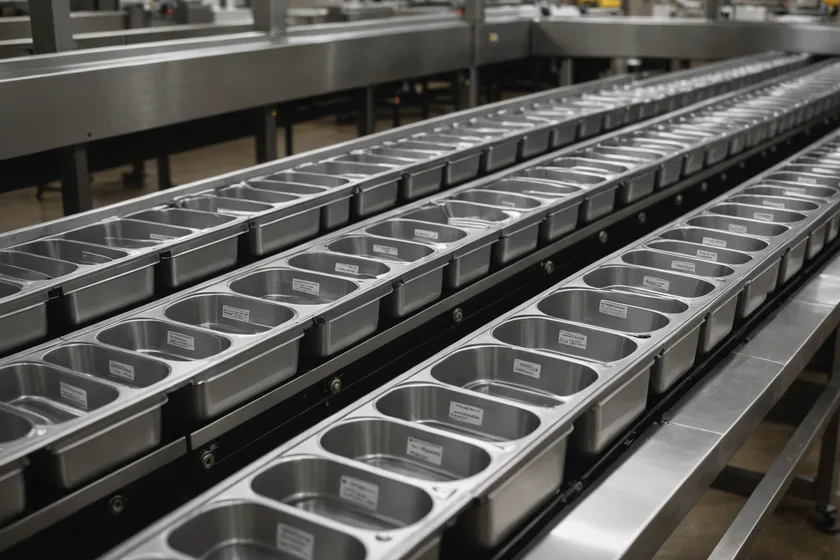
Label alignment defects are deceptive. Hold a mislabeled jar in your hand and the product looks fine — the lid is sealed, the food inside is correct, the label is present. The skew might not even be visible to casual inspection at a glance. You'd have to hold it up to a reference to notice the drift. And then the barcode scanner at the retailer's receiving dock refuses to read it, and the pallet is rejected.
This gap between "visually acceptable to a human holding it" and "functionally rejected by automated receiving systems" is exactly where label inspection adds the most value on a food production line. The defect is real, the downstream cost is concrete, and the inspection problem is one that camera systems handle well.
Why Label Applicators Drift
Label applicators on food production lines are mechanical devices with wear characteristics that QA teams need to understand. The most common label applicator design — tamp-apply or wipe-apply — uses a dispensing head that positions and applies each label as containers pass beneath or beside it. The accuracy of application depends on the mechanical alignment of the head, the consistency of container positioning, label stock consistency (roll tension, liner slippage), and temperature.
Drift occurs because these variables aren't constant over a production shift. As the label roll decreases in diameter, the unwind tension changes and affects the peel point timing. The dispensing head warms slightly over hours of operation, changing mechanical dimensions at the micrometer scale. Container positioning from an upstream conveyor can vary within its own tolerance band. Each of these is a small effect; combined and accumulated over thousands of cycles, they produce measurable positional drift.
The practical result is that a line that starts a shift with label placement within ±0.5mm of nominal may drift to ±3mm by the end of the shift — well outside the tolerance for reliable barcode scanning on most label stock and barcode types. This drift is predictable and manageable, but only if you're measuring it.
What Vision Inspection Actually Measures
Camera-based label inspection measures position, orientation, and presence. It does not, by default, verify the content of the label (what's printed on it) or the barcode data — those require additional integrated modules. Understanding what the base inspection checks are helps set appropriate expectations.
Position offset. The camera captures each container in a fixed field of view, with the label's expected position defined by a reference template established during system setup. The inspection compares the detected label edges to the reference template and measures the offset in x (horizontal), y (vertical), and optionally rotational (angular skew). Position offset measurements in the ±0.3mm to ±0.5mm range are standard on well-calibrated systems at 400–600 units per minute.
Presence detection. Simpler than position measurement but high-value: is a label present at all? Missing labels — caused by label stock runout, applicator jam, or dispensing failure — are straightforward to detect. A container with no label in the expected zone is an unambiguous absence signal. This check has very low false reject rates because the signal is binary.
Angular rotation. A label that's applied with rotational skew — tilted rather than just shifted — creates a more complex barcode scan failure than a simple position offset, because scanners that can compensate for position variation often can't compensate for angle. Measuring angular skew requires detecting the label's orientation rather than just its centroid position; modern camera systems running edge detection can do this reliably.
Wrinkle and lift detection. Labels that are partially detached from the container surface, wrinkled, or have lifted corners create both barcode scan failures and aesthetics issues. Camera systems can detect the shadow patterns and edge irregularities caused by label lifting, though this is a more complex detection task than pure position measurement.
Barcode Scan Integration: The Complete Check
Position measurement alone tells you whether the label is where it's supposed to be. It doesn't tell you whether the barcode on that label will actually scan under realistic receiving conditions. For high-stakes applications — products going to retailers with strict incoming scan requirements — the complete check combines camera position measurement with barcode decode verification.
In an integrated setup, the camera simultaneously captures the label image for position measurement and passes the barcode region to a decode module (either a dedicated 1D/2D barcode reader or a software decode running on the same frame). If the barcode decodes successfully at a defined read rate (typically 95% or better), the unit passes. If the decode fails — because of print contrast issues, label orientation, or damage — the unit is rejected regardless of whether the position measurement would have passed.
This combined check catches two different failure modes: position drift that places the barcode outside reliable scanner range, and print quality issues that would cause scan failure even if the label were perfectly positioned. Both modes lead to the same downstream outcome (dock scan failure), and both are preventable at the line.
Setting Tolerances for Your Specific Application
The tolerance you set for label position inspection needs to be calibrated to your downstream scanning requirements, not just to an arbitrary precision target. Tighter isn't always better — setting a position tolerance of ±0.3mm when your product actually needs ±1.0mm to be functionally acceptable will drive false rejects on good product without improving your downstream defect rate.
The right tolerance derivation process starts with your retailers' barcode scanning specifications (most publish minimum scan reliability standards for incoming product), works backward through label design parameters (barcode quiet zone width, print resolution), and sets the position tolerance to the maximum offset at which a correctly printed barcode will reliably scan at your retailers' scanners.
For a standard 1D EAN/UPC barcode at typical label sizes used in food packaging, a position offset of more than 3–4mm typically starts creating scan reliability issues. A rotational skew beyond 5–8 degrees is often the threshold for scan failure. Both are well within the detection capability of production-grade camera systems, meaning the inspection problem here is tractable — you don't need extreme precision to catch the defects that actually cause rejections.
A Scenario: Drift Detection on a Deli Container Line
Consider an inline inspection deployment on a deli container line running 520 units per minute — a mix of three SKUs with different label positions on the container face. The label applicator for one SKU was showing intermittent drift that wasn't being caught by the end-of-shift inspection check, because the drift was worst in the middle of the shift and had partially corrected by end-of-shift when sample inspection occurred.
After deploying inline vision inspection, the system's log data showed a clear pattern: label position on that SKU drifted to ±2.8mm offset between hours 3 and 6 of each shift, correlating with the production environment reaching peak temperature. The afternoon shift had a higher rejection incident rate at retailers — a correlation that was visible in the shipping records but had no root cause until the per-unit inspection data connected it to the applicator drift window.
The fix was a temperature-compensated position check on the applicator itself — a $40 modification to the applicator mount — combined with a mid-shift maintenance reminder. The per-unit inspection data provided the evidence that a sampling-based system couldn't have generated.
What This Inspection Doesn't Cover
To be clear about scope: position and presence inspection verifies that the label is where it should be and can be read. It does not verify that the right label was applied to the right product — that's a mispack detection problem requiring SKU verification, which needs barcode decode against an order manifest or a more sophisticated label content check. It also doesn't catch print quality defects that fall within position tolerance — a perfectly positioned label with an illegible date code is a separate inspection check.
Label alignment inspection is one layer in a complete inline QA setup, not the entire quality system. But for manufacturers where label-related dock rejections are a top cost driver — which, based on the rejection cause breakdowns discussed in our earlier post, is a significant portion of food manufacturers shipping to retail — it's the layer that addresses the largest share of the problem directly, at line speed, before product leaves the building.