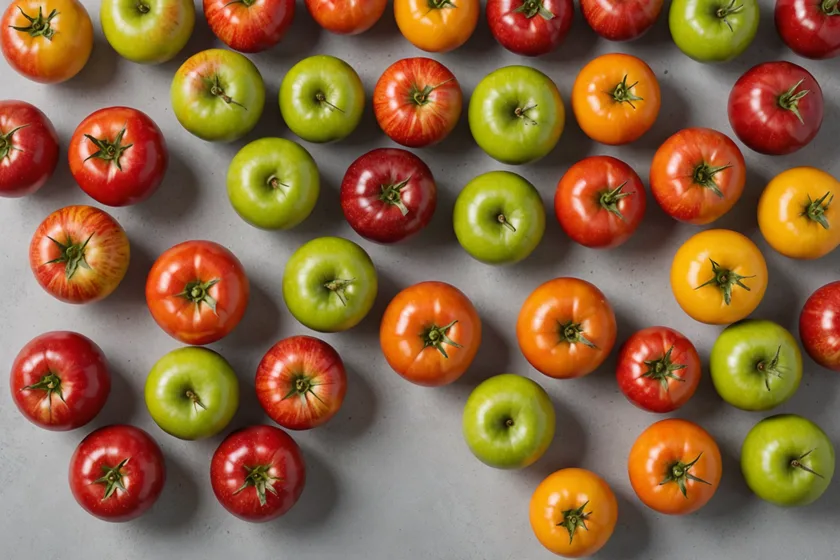
The problem with manual color grading isn't that human QA inspectors are incompetent. The problem is that color perception is inherently subjective, fatigues over a shift, varies between individuals, and changes with ambient lighting conditions on the pack floor. Two experienced graders on the same line will disagree on borderline fruit at a rate that would concern any QA manager looking at the interrater reliability numbers. And yet produce color grade directly determines whether a unit ships to premium retail, gets downgraded to processing, or gets rejected entirely.
Machine vision-based color grading doesn't solve this by being infallible. It solves it by being consistent — applying the same measurement against the same reference, at every unit, across every shift, and recording the result with a timestamp and an image. That consistency is the foundation for reliable grade-based sorting and for the documentation your retail customers increasingly expect.
Why RGB Is the Wrong Color Space for Grading
Most industrial cameras capture images in RGB. RGB values are useful for display purposes but are a poor basis for color measurement because they conflate color information with luminance. A tomato photographed under slightly different lighting intensities will produce different RGB values even if its actual surface color hasn't changed. This creates a problem for inline color grading: small changes in illumination — LED temperature drift over time, a light source partially blocked by product accumulation, a cleaning cycle that moves a light panel by 5mm — will appear as color changes to an RGB-based system.
The standard approach to this problem is to work in CIELAB color space, commonly called L*a*b*. CIELAB separates luminance (L*) from the two color-opponent channels (a* for green-to-red, b* for blue-to-yellow). Color difference in CIELAB is measured as delta-E, a single number that represents perceptual color difference between two measurements. A delta-E of 1 corresponds approximately to the threshold of human perceptible color difference under controlled conditions; delta-E values above 3-4 represent differences clearly visible to most observers.
Working in CIELAB rather than RGB makes the color measurement much more robust to illumination variation, because you can normalize the L* channel independently. A unit's a* and b* values give you a stable measure of its actual color that doesn't drift with moderate illumination changes. This is why colorimetry instruments in food science (spectrophotometers, colorimeters) have reported in CIELAB since the 1970s — it's not a new idea, machine vision is just now applying it inline.
Defining the Grade Reference and Tolerance
Before calibrating a vision grading system, you need to define what each grade means in quantitative CIELAB terms. This is a step that surprises growers and processors who are accustomed to working with descriptive color standards (the USDA Color Standards for Tomatoes, for example, define grades in terms of visual reference cards) or with sample fruit reviewed by a senior grader.
The conversion process: take physical reference samples at the grade boundary, measure them with a calibrated colorimeter or spectrophotometer, and record the L*a*b* coordinates. These become the reference centroids for each grade. The tolerance — the delta-E distance from the reference centroid within which a unit falls into that grade — needs to be set empirically using a set of borderline examples rated by your expert graders. The goal is to reproduce what your best grader would decide, as a quantitative rule, not to invent a new specification from scratch.
For red tomatoes destined for a major UK multiple-retailer specification, for example, grade "Class 1" might require an a* value above +28 (indicating sufficient red saturation) and a delta-E of less than 6.0 from the Class 1 centroid. Fruit falling outside this tolerance gets automatically sorted to Class 2 or processing. The retailer specification is operationalized as a numeric rule rather than a human judgment call.
Illumination Design Matters More Than Camera Choice
The accuracy of a color grading system depends more on illumination quality than on camera resolution or model sophistication. Illumination design for color work requires: color-stable light sources with a Color Rendering Index (CRI) of 95 or higher (many standard industrial LED panels have CRI of 80-85, which is adequate for defect detection but marginal for color grading), consistent coverage across the full conveyor width without hot-spots or shadows, and a geometric arrangement that minimizes specular reflection from produce surfaces.
Specular reflections are particularly problematic for color grading on glossy produce — tomatoes, peppers, apples. A specular highlight appears as a near-white patch regardless of the fruit's actual color, and any pixels in that region will read inaccurate color values. The solution is either a diffuse illumination dome that eliminates direct specular paths, or a cross-polarized lighting arrangement that filters specular reflection while passing diffuse reflection. Both add cost and setup complexity, but they're necessary for reliable color measurement on glossy produce at line conditions.
We're not suggesting that every fresh produce line needs a custom illumination enclosure. For products with matte or low-gloss surfaces — stonefruit, many root vegetables, soft berries — the illumination requirements are more forgiving and a well-configured LED ring or bar array will produce reliable color data. The specular problem is specific to glossy products and should be assessed for each product category.
A Practical Example: Stone Fruit Sorting at Pack Speed
Consider a stone fruit packer running peaches at approximately 180-220 units per minute on a single-lane conveyor with roller transfer for fruit rotation. The pack house sorts product into three color grades for two different retailer specifications — one requiring higher red blush coverage, one accepting lower minimum blush.
Under manual grading, each inspector makes a visual decision on every piece. Across an eight-hour shift, with two inspectors on the grading table, inter-rater disagreement on borderline blush pieces runs at roughly 15-18% in the peak season weeks when fruit maturity is most variable. This creates inconsistency in grade distribution across shifts and generates complaints from the higher-specification retailer when borderline pieces slip through in the wrong direction.
A vision grading system calibrated against the retailer-specified CIELAB reference measures blush coverage percentage (fraction of surface area above a minimum a* threshold) and mean a* in the blush zone, and applies the decision rule consistently at line speed. Disagreement between the vision system and an independent check grader on the same units, measured over a two-week validation period, runs at 8-10% — lower than the human inter-rater disagreement rate, and with the system's decisions fully traceable to the measurement data. The higher-specification retailer receives an audit log showing per-pallet grade measurement data for each shipment.
What Machine Vision Color Grading Cannot Replace
Color grading by camera measures surface color. It does not measure ripeness indicators that are not surface-visible — internal flesh color in some stonefruit, Brix content, firmness. These require either destructive sampling, non-invasive NIR spectroscopy, or ultrasound methods. A tomato can measure correctly on surface color while being internally green; a peach can have excellent blush coverage while being internally hard. For complete ripeness quality assessment, color grading is one input in a broader QC process, not a complete solution.
Color measurement is also SKU-specific. The CIELAB reference and tolerance values for Roma tomatoes are different from those for beefsteak tomatoes, and both differ from cherry tomatoes. A system calibrated for one variety will produce unreliable results on another. Per-SKU color profiles must be maintained and updated when raw material variety or supplier changes — the same maintenance requirement that applies to defect detection model thresholds.
The transition from human color judgment to camera-based CIELAB measurement is a process change as much as a technology change. The specification has to be rewritten in numeric terms, the grade boundaries have to be agreed with the downstream customers in quantitative terms, and the inspectors whose judgment you're partially replacing need to understand that the system is reproducing their best judgment consistently, not overriding their expertise. Getting that alignment done properly at the start is what makes the color grading deployment stick.